
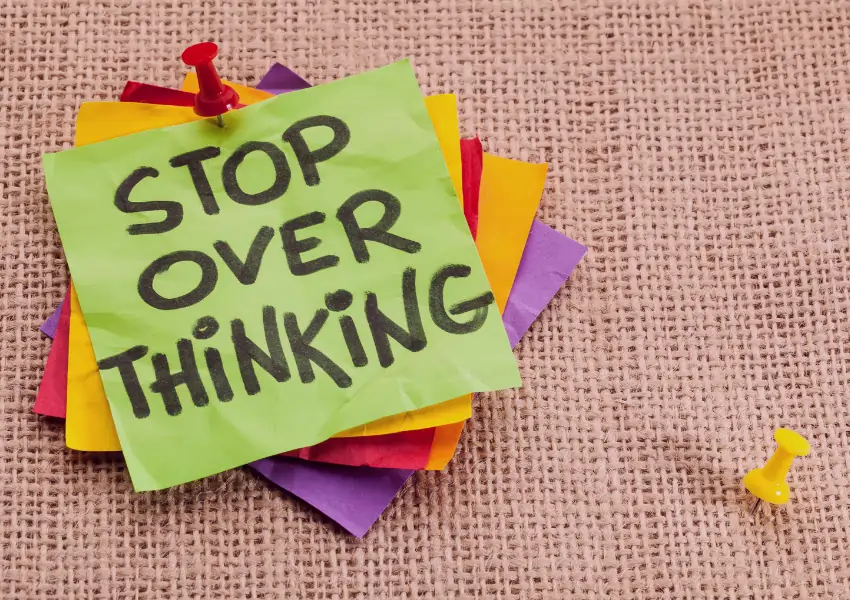
You already know the answer. Somewhere underneath the noise beneath the what-ifs, the replayed conversations, the imagined worst-case scenarios, and the endless loop of decisions that should have taken three minutes but somehow consumed three hours you already know what you think, what you want, and what you need to do next.
Overthinking is not a sign of high intelligence. It is not careful planning. It is not thoroughness dressed up as anxiety. Overthinking is what happens when the mind has been trained to distrust itself when personal growth has been replaced by endless analysis, when self improvement has become another word for self interrogation, and when the search for the perfect answer has quietly become more important than any answer at all.
Learning how to stop overthinking is not about thinking less. It is about thinking better. It is about recovering the mental clarity, inner peace, and self awareness that excessive rumination quietly steals one anxious thought at a time.
If your mind is the noisiest room you enter every day, this guide is for you. Not because it will hand you a quick fix nothing worth having arrives that way but because it will show you exactly what is driving the loop, why standard advice rarely touches it, and what actually works for people who are genuinely ready to change the way their mind operates.
At SalsSky, the belief is that a quiet mind is not a passive mind. It is a sovereign one. And sovereignty over your thoughts, your reactions, your inner life is available to everyone willing to do the real work of reclaiming it.
What Is Overthinking Really And Why Is It So Hard to Stop?
Most people think overthinking is a thinking problem. It is not. It is a trust problem.
At its core, overthinking is the mind’s response to a perceived lack of safety. When you do not fully trust your own judgment when self awareness has been replaced by self doubt, when personal growth has stalled because every decision feels too significant to make without certainty the mind compensates by generating more thoughts. More options. More analysis. More scenarios.
The logic, underneath it all, is this: if I think about this enough, I will eventually find the answer that feels completely safe. The problem is that feeling completely safe about an uncertain future is neurologically impossible. The brain cannot guarantee outcomes. So it keeps searching. And searching. And the loop continues.
Here is what makes how to stop overthinking particularly difficult:
- The overthinking itself feels productive. It masquerades as careful consideration, responsible planning, and thorough self improvement. From the inside, it is almost indistinguishable from good thinking.
- It is self-reinforcing. The more you analyse a problem, the more complex it appears, which generates more thoughts, which require more analysis.
- Standard advice does not reach it. Being told to think positively, stay present, or just make a decision does not address the underlying trust deficit driving the behaviour.
- It steals the present. While you are rehearsing the future or replaying the past, the actual life you are meant to be living passes by unnoticed and unlived.
Understanding why you overthink is the first real step toward how to stop overthinking. Not because insight alone solves it it does not but because it stops you from fighting the symptom while ignoring the cause.
What Does Overthinking Actually Do to Your Brain and Body?
Before addressing how to stop overthinking, it is worth understanding what it costs you because most people significantly underestimate the damage that chronic mental rumination produces.
Research from Yale University found that rumination the clinical term for repetitive, passive negative thinking is one of the strongest predictors of depression and anxiety disorders. It is not a harmless habit. It is a physiologically expensive one.
Here is what chronic overthinking does:
- Elevates cortisol levels continuously, keeping the body in a low-grade stress state that affects sleep, digestion, immunity, and cardiovascular health
- Shrinks the hippocampus over time the brain region responsible for memory, learning, and emotional regulation
- Reduces activity in the prefrontal cortex, impairing the very decision-making capacity you are trying to use to resolve the problems you are overthinking
- Increases inflammation markers in the body, linking chronic mental stress to physical illness
- Depletes cognitive resources, leaving you mentally exhausted by thoughts that produced no useful output
The cruel irony of overthinking is that the more you do it, the worse your thinking becomes. The mind you are using to solve problems is being progressively degraded by the very process you are relying on to solve them.
This is not about willpower. This is neuroscience. And how to stop overthinking is ultimately a question of giving the brain what it needs to regulate itself which is something very different from simply trying harder to think less.
Why Does Overthinking Get Worse at Night?
Almost everyone who struggles with how to stop overthinking reports that it is dramatically worse at night. There is a specific neurological reason for this, and understanding it matters.
During the day, the brain has sensory input competing for its attention tasks, conversations, environments, obligations. This external stimulation partially suppresses the default mode network, which is the brain system responsible for self-referential thinking, future simulation, and memory replay. In other words, the network most responsible for overthinking.
At night, when external stimulation drops away, the default mode network activates strongly. With nothing competing for attention, every unresolved thought, unmade decision, and unprocessed emotion gets its turn. The mind, with nowhere external to go, turns inward and for an overthinker, inward is where the noise lives.
What this means practically:
- Processing difficult thoughts earlier in the day rather than pushing them aside significantly reduces nighttime rumination
- A consistent wind-down routine that gradually reduces stimulation signals the default mode network to quieten before sleep
- Writing unresolved thoughts down before bed not to solve them, but simply to externalise them reduces the brain’s perceived need to keep holding them in active memory
- Physical activity during the day reduces cortisol levels and gives the nervous system a discharge outlet that mental activity alone cannot provide
How to Stop Overthinking What Actually Works
This is not a list of surface-level tips. Every approach below addresses a specific mechanism driving the overthinking loop which is why they work when generic advice does not.
Interrupt the loop with physical movement immediately
When overthinking activates, it creates a neurological loop that thought alone cannot break. The most effective immediate interruption is physical movement not because exercise solves the problem, but because it shifts blood flow, changes neurochemical balance, and provides the nervous system with a discharge outlet that breaks the loop long enough for you to regain perspective.
Even two minutes of walking, stretching, or any deliberate physical activity interrupts the cycle more effectively than any cognitive technique applied while sitting still.
Name what you are actually afraid of
Overthinking is almost always fear wearing the costume of planning. The question how to stop overthinking is frequently answered by a simpler question: what am I actually afraid will happen?
Most people who overthink are not thinking about the problem they appear to be thinking about. They are avoiding a fear that sits underneath it fear of failure, rejection, making the wrong choice, being seen as incompetent, or losing something they value. The surface problem is the distraction. The fear is the engine.
When you name the actual fear directly out loud or on paper the grip of the overthinking loop loosens significantly. Not because naming it resolves the fear, but because it moves the brain from abstract rumination to concrete problem identification. And concrete problems can be addressed. Abstract spirals cannot.
Set a deliberate thinking window
One of the most counterintuitive but evidence-backed approaches to how to stop overthinking is to schedule your worry rather than suppress it. Research from Penn State University found that participants who designated a specific 30-minute window each day for deliberate worry thinking showed significantly reduced intrusive thoughts outside that window compared to those who tried to suppress anxious thoughts entirely.
The brain, when told it will have time to process something later, is better able to defer that processing than when told it is not allowed to think about something at all. Suppression increases intrusion. Permission decreases it.
Use the 10-10-10 clarity method
When a decision or situation is generating a disproportionate amount of mental noise, ask three questions:
- Will this matter in 10 minutes from now
- Will this matter in 10 months from now
- Will this matter in 10 years from now
This is not a trivialising exercise. It is a perspective calibration. Most of what overthinkers spend the majority of their mental energy on sits firmly in the 10-minutes-only category. The 10-10-10 method makes that visible quickly.
Distinguish between productive and unproductive thinking
Not all thinking is overthinking. The key distinction is whether the thinking is generating new useful information or simply recycling the same information in a loop.
Ask yourself: has this thought produced anything new in the last five minutes? If the answer is no if you are thinking the same thoughts in slightly different configurations you are no longer problem-solving. You are ruminating. The moment you can identify that distinction, you have the awareness needed to make a different choice.
Build self awareness as a daily practice
The long-term answer to how to stop overthinking is not a technique. It is a fundamental shift in your relationship with your own mind from one of unconscious reaction to one of deliberate observation.
Self awareness is the capacity to notice your thoughts without being completely consumed by them. To observe the loop without being trapped inside it. This is developed through consistent practice meditation, contemplative reading, journaling with specific self-inquiry prompts, and any practice that creates a consistent gap between stimulus and response.
This gap even a fraction of a second wide is where the choice to stop overthinking lives. And it grows with practice until it becomes the dominant mode of operation rather than the occasional exception.
Address the deeper trust deficit
How to stop overthinking at the root level requires addressing the thing that started it. At some point usually early and usually in response to an environment where mistakes were costly or unpredictable you learned to distrust your own judgment. To second-guess your perceptions. To submit every intuition to an exhausting review process before allowing yourself to act on it.
That learned distrust is the engine of chronic overthinking. And the answer is not more self discipline applied to thinking less. The answer is rebuilding trust in your own perception through experience, through self-inquiry, through the accumulated evidence of being someone who makes decisions, lives with them, and survives the uncertainty.
This is the work that most how to stop overthinking advice never reaches. It is also the work that makes the most lasting difference.
What Happens to Your Life When You Stop Overthinking?
The benefits of learning how to stop overthinking extend far beyond simply feeling calmer. The downstream effects touch every area of life.
Here is what changes:
- Decision-making becomes faster and more accurate because you are accessing your actual judgment rather than running it through an endless review process
- Relationships deepen because you are present in conversations rather than simultaneously processing seventeen hypothetical versions of how they might go wrong
- Creativity returns overthinking suppresses the spontaneous associative thinking that produces insight and innovation
- Sleep quality improves dramatically the nighttime loop quietens as the daytime processing becomes more effective
- Energy levels rise the cognitive load of chronic rumination is exhausting in ways that are invisible until it stops
- Self confidence builds naturally because you discover, repeatedly, that your judgment is more reliable than your overthinking told you it was
- Inner peace becomes available not as a destination to reach but as a state that emerges naturally when the noise quietens enough to hear what was always underneath it
The Deeper Truth About How to Stop Overthinking
Here is what almost nobody says directly: overthinking is not the enemy. It is a signal.
It signals that something in your inner world does not feel safe enough to trust. A decision that feels too big. A self-image that feels too fragile. A life that, underneath the surface, does not quite feel like yours.
The people who genuinely learn how to stop overthinking are not the ones who get better at suppressing thoughts. They are the ones who address what the overthinking was pointing toward all along. Who do the deeper work of understanding themselves clearly enough that the mind no longer needs to run its exhausting protective programme.
That is not a technique. That is a transformation.
Your Mind Has Been Waiting for This
You have spent long enough inside the loop. Long enough running the same thoughts through the same tired review process and arriving at the same place you started a little more exhausted, a little less certain, and no closer to the quiet you have been looking for.
The noise in your head is not who you are. It is what happens when the real you has been waiting too long to be heard.
If you are ready to go beyond techniques and into the transformation that makes genuine mental clarity not just possible but permanent the next step is already waiting.
Begin Your Ascendancy and discover the six-chapter narrative journey that has helped thousands of people across 40 countries stop managing the noise and start living from the quiet underneath it. One read. One decision. The loop ends here.
Frequently Asked Questions
What is overthinking and why does it happen?
Overthinking is repetitive, unproductive mental rumination driven by a deep distrust of one’s own judgment. It happens when the mind perceives uncertainty as unsafe and compensates by generating more analysis in a search for certainty that never arrives. It is not a thinking problem. It is a trust problem.
How do I stop overthinking immediately in the moment?
The fastest immediate intervention is physical movement. Stand up, walk, stretch anything that changes your physical state. This interrupts the neurological loop more effectively than any cognitive technique applied while sitting still. Follow it by naming the specific fear underneath the thought rather than continuing to analyse the surface problem.
Does overthinking mean I have anxiety?
Not necessarily. Overthinking and anxiety are closely related but not identical. Overthinking is a thinking pattern. Anxiety is a physiological and psychological condition. Many people overthink without meeting the clinical criteria for an anxiety disorder. However chronic overthinking, if unaddressed, significantly increases the risk of developing anxiety and depression over time.
Why is overthinking so much worse at night?
Because the default mode network the brain system responsible for self-referential thinking and mental replay activates strongly when external stimulation drops away at night. The solution is to process difficult thoughts deliberately during the day rather than pushing them aside, and to build a wind-down routine that gradually quietens the nervous system before sleep.
Can mindfulness really help with how to stop overthinking?
Yes but not the version of mindfulness that asks you to empty your mind. That approach frequently increases frustration in overthinkers. The version that works is open, non-judgmental observation of thoughts without engagement. You are not trying to stop thoughts. You are learning to watch them without following them. That distinction is everything.
Is overthinking a sign of intelligence?
This is a common and comforting belief but largely a myth. Research consistently shows that overthinking is associated with reduced decision-making quality, not improved outcomes. Genuinely strategic thinkers know when to stop gathering information and act. Overthinking is not deep thinking. It is thinking that has lost its exit.
How long does it take to stop overthinking permanently?
Most people notice meaningful reduction in overthinking within two to four weeks of consistent practice using the right approaches. Complete resolution of the underlying pattern the trust deficit driving the behaviour takes longer and requires deeper work than surface techniques alone can reach. The timeline depends entirely on how deeply the work goes.
What is the root cause of chronic overthinking?
The root cause is almost always a learned distrust of one’s own judgment formed early in life in response to environments where mistakes felt costly or unpredictable. The mind learned that more analysis meant more safety. That programme runs automatically until it is examined directly and replaced with accumulated evidence of one’s own reliable perception. That is the work that makes the difference permanently.