
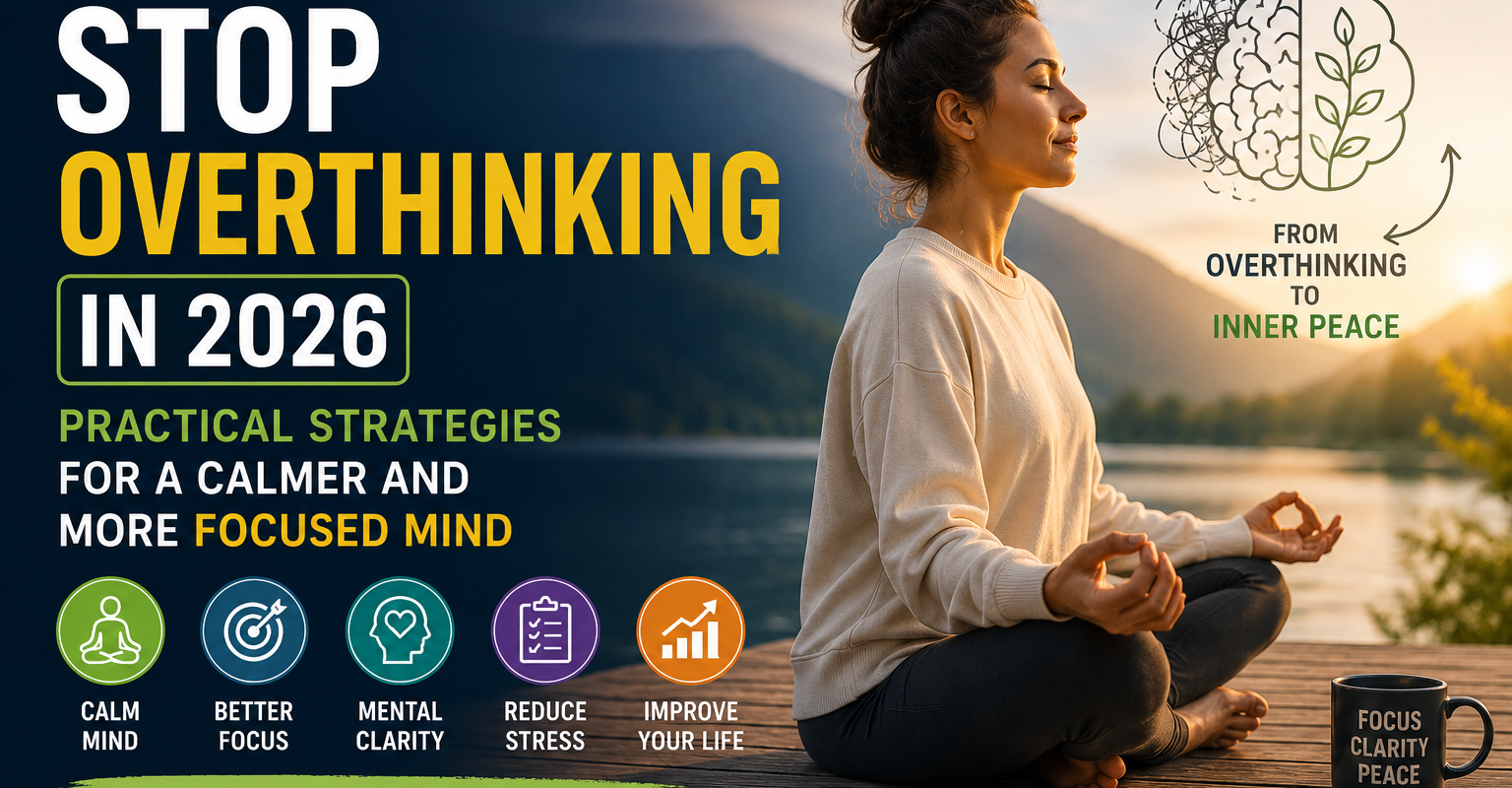
Have you ever found yourself replaying the same conversation over and over in your mind? Do you constantly worry about the future, analyze every decision, or imagine worst-case scenarios?
If so, you’re not alone.
Overthinking has become one of the biggest mental challenges in today’s fast-paced world. With constant notifications, endless information, social media comparisons, and increasing life pressures, many people struggle to quiet their minds.
The good news is that overthinking is a habit, and like any habit, it can be changed.
Learning how to stop overthinking can improve your mental clarity, reduce stress, strengthen self-confidence, and help you focus on what truly matters.
In this guide, you’ll discover practical strategies to stop overthinking and create a calmer, more focused mind in 2026.
What Is Overthinking?
Overthinking is the habit of dwelling excessively on thoughts, situations, problems, or decisions.
Instead of helping you find solutions, overthinking often creates:
- Mental exhaustion
- Increased stress
- Anxiety
- Reduced productivity
- Self-doubt
- Difficulty making decisions
Many people believe thinking more leads to better outcomes. In reality, excessive thinking often creates confusion rather than clarity.
Understanding how to stop overthinking starts with recognizing that not every thought deserves your attention.
Why Overthinking Is More Common in 2026
Modern technology has made information available 24/7.
While this has many benefits, it also creates challenges.
Common triggers of overthinking include:
Information Overload
Your brain processes thousands of messages, headlines, videos, and updates daily.
Social Media Comparison
Seeing curated versions of other people’s lives can create unnecessary self-doubt.
Fear of Failure
Many people hesitate to act because they fear making mistakes.
Uncertainty About the Future
Economic changes, AI advancements, and career shifts can create anxiety about what’s ahead.
These factors make learning how to stop overthinking more important than ever.
Signs That You’re Overthinking
You may be overthinking if you frequently:
- Replay past mistakes
- Worry about future outcomes
- Analyze every conversation
- Struggle to make decisions
- Seek constant reassurance
- Imagine negative scenarios
- Have trouble relaxing
Recognizing these patterns is the first step toward change.
Why Overthinking Is Harmful
Many people assume overthinking helps them stay prepared.
However, excessive thinking often creates more problems than solutions.
Increased Stress
Overthinking keeps your mind in a constant state of alertness.
Reduced Productivity
Too much analysis can lead to procrastination and inaction.
Lower Self-Confidence
Constant self-questioning weakens trust in your own judgment.
Emotional Exhaustion
Mental energy is limited. Overthinking drains that energy quickly.
Understanding these consequences can motivate you to learn how to stop overthinking effectively.
1. Focus on What You Can Control
One of the most effective ways to stop overthinking is to separate what you can control from what you cannot.
Ask yourself:
“What action can I take right now?”
Focus your energy on actions rather than endless possibilities.
When you concentrate on what is within your control, your mind naturally becomes calmer.
2. Set Time Limits for Decision-Making
Many people overthink because they believe there is a perfect choice.
In reality, most decisions do not require endless analysis.
Try giving yourself a deadline.
For example:
- Small decisions: 5 minutes
- Medium decisions: 30 minutes
- Major decisions: 24 to 48 hours
This approach reduces mental clutter and encourages action.
3. Challenge Negative Thoughts
Not every thought is true.
When negative thoughts appear, ask:
- Is this fact or assumption?
- What evidence supports this belief?
- What evidence contradicts it?
This simple exercise improves mental clarity and reduces unnecessary worry.
4. Practice Mindfulness
Mindfulness helps you stay focused on the present moment.
Most overthinking occurs when your mind is trapped in the past or future.
Simple mindfulness practices include:
- Deep breathing
- Meditation
- Walking without distractions
- Paying attention to your surroundings
Mindfulness is one of the most powerful tools for anyone learning how to stop overthinking.
5. Take Immediate Action
Action is the enemy of overthinking.
The longer you delay, the more opportunities your mind has to create doubts and fears.
Instead of asking:
“What if it goes wrong?”
Ask:
“What is the next small step I can take?”
Small actions create momentum and reduce mental resistance.
6. Limit Information Consumption
More information does not always lead to better decisions.
Many people consume excessive amounts of content while searching for certainty.
Consider:
- Reducing news consumption
- Limiting social media usage
- Avoiding endless research
Mental clarity often comes from simplifying inputs rather than adding more.
7. Stop Seeking Perfection
Perfectionism fuels overthinking.
When you expect perfection, every decision feels high-stakes.
Remember:
Progress is more valuable than perfection.
Successful people take action, learn, adjust, and continue moving forward.
They do not wait for perfect conditions.
8. Write Down Your Thoughts
Journaling is an effective technique for managing mental clutter.
When thoughts stay inside your head, they often feel overwhelming.
Writing helps:
- Organize ideas
- Reduce anxiety
- Increase self-awareness
- Identify recurring thought patterns
Even five minutes of journaling each day can make a significant difference.
9. Build Self-Confidence
Low self-confidence often leads to excessive thinking.
People who trust themselves spend less time questioning every decision.
Build self-confidence by:
- Keeping promises to yourself
- Learning new skills
- Celebrating small wins
- Practicing self-discipline
As confidence grows, overthinking naturally decreases.
10. Focus on Personal Growth
Personal growth shifts your attention from fear to improvement.
Instead of worrying about mistakes, view them as opportunities to learn.
Ask yourself:
“What can this experience teach me?”
This mindset creates resilience and emotional strength.
Personal development is not about avoiding failure. It is about becoming stronger through experience.
Creating a Calmer Mind in 2026
A calmer mind is not created by eliminating all problems.
It is created by changing your relationship with your thoughts.
People who know how to stop overthinking understand that:
- Thoughts are not facts
- Action creates clarity
- Progress matters more than perfection
- The present moment deserves attention
The goal is not to stop thinking entirely.
The goal is to think productively instead of endlessly.
Final Thoughts
Learning how to stop overthinking is one of the most valuable skills you can develop in 2026.
Overthinking steals time, energy, confidence, and peace of mind. By focusing on action, practicing mindfulness, limiting information overload, and strengthening self-confidence, you can regain control of your thoughts.
Remember that change happens gradually.
Start with one strategy today.
Then practice it consistently.
Over time, you’ll notice greater mental clarity, improved focus, reduced stress, and a stronger sense of calm.
Your mind works best when it serves you—not when it controls you.