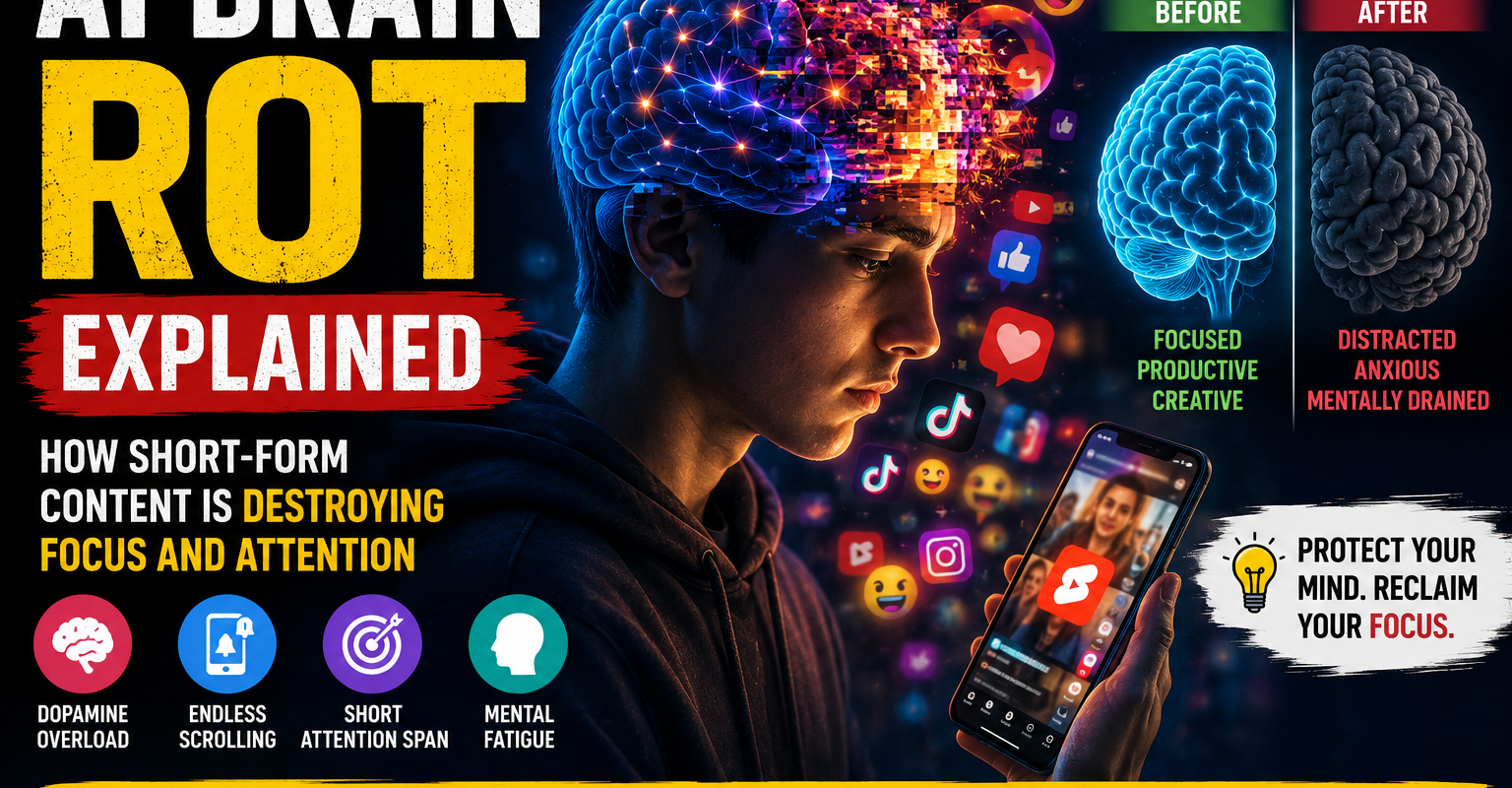
Modern technology has completely changed the way people consume information. Social media feeds, AI-generated content, endless scrolling, short videos, and constant notifications have created a new digital behavior problem often called AI brain rot.
People are spending hours every day consuming extremely fast and stimulating content. While this entertainment may feel harmless, many experts believe it is damaging:
- focus
- attention span
- productivity
- memory
- motivation
- mental clarity
The term AI brain rot has become increasingly popular because people are noticing major changes in their thinking patterns and concentration levels.
Many individuals now struggle to:
- focus on reading
- complete deep work
- study consistently
- avoid distractions
- stay mentally present
This issue is strongly connected with:
- dopamine overload
- social media addiction
- digital overstimulation
- short-form content consumption
In this article, you will learn:
- what AI brain rot means
- how short-form content affects the brain
- why attention spans are shrinking
- how dopamine overload impacts focus
- signs of digital overstimulation
- ways to improve concentration naturally
What Is AI Brain Rot?
AI brain rot refers to mental fatigue and reduced attention span caused by excessive consumption of highly stimulating digital content.
The phrase became popular online as people noticed how constant scrolling and AI-generated entertainment were changing human behavior.
AI brain rot is often associated with:
- TikTok addiction
- endless short videos
- AI-generated content overload
- meme culture
- constant notifications
- rapid content consumption
The human brain was not designed to process endless streams of fast-moving stimulation for hours every day.
Over time, this constant stimulation can reduce the brain’s ability to:
- focus deeply
- stay patient
- enjoy slower activities
- maintain concentration
- think critically
How Short-Form Content Affects the Brain
Short-form content is designed to capture attention instantly.
Platforms use algorithms that continuously show highly engaging videos, images, and content to maximize screen time.
This creates rapid dopamine stimulation in the brain.
Dopamine is a neurotransmitter connected with:
- reward
- motivation
- pleasure
- attention
Every swipe, notification, or entertaining video provides small dopamine rewards.
Over time, the brain becomes accustomed to constant stimulation. As a result:
- longer tasks feel boring
- patience decreases
- concentration weakens
- productivity declines
This is one of the biggest effects of AI brain rot.
Why Attention Spans Are Shrinking
Many people now struggle to focus on:
- books
- conversations
- studying
- work tasks
- long videos
This happens because the brain adapts to fast-paced digital stimulation.
Short-form content trains the brain to expect:
- instant rewards
- rapid entertainment
- constant novelty
As a result, slower activities feel mentally uncomfortable.
AI brain rot weakens the brain’s ability to tolerate boredom, which is important for:
- creativity
- learning
- deep thinking
- problem-solving
Without boredom, the brain rarely enters deeper states of focus.
The Dopamine Overload Problem
One major cause of AI brain rot is dopamine overload.
Modern apps are specifically designed to keep users engaged for as long as possible.
Features like:
- infinite scrolling
- autoplay videos
- algorithmic recommendations
- instant notifications
constantly stimulate the brain’s reward system.
Too much dopamine stimulation can reduce sensitivity to normal activities.
This means simple tasks like:
- reading
- exercising
- studying
- working
begin to feel less rewarding compared to digital entertainment.
Over time, this can lead to:
- procrastination
- low motivation
- poor focus
- mental exhaustion
Signs of AI Brain Rot
Many people do not realize how much digital overstimulation is affecting them.
Common signs of AI brain rot include:
- difficulty concentrating
- constantly checking the phone
- short attention span
- inability to sit quietly
- poor memory
- procrastination
- low motivation
- mental fatigue
- dependence on entertainment
People experiencing AI brain rot often feel restless when not consuming content.
Even short moments of silence may feel uncomfortable.
Social Media Addiction and Mental Performance
Social media platforms compete aggressively for human attention.
The more time users spend scrolling, the more profit platforms generate through advertising and engagement.
This creates systems designed to maximize addiction-like behavior.
Excessive social media use can negatively affect:
- self discipline
- emotional balance
- productivity
- focus
- confidence
Many people compare themselves constantly online, which can also damage:
- self confidence
- mental health
- emotional well-being
AI brain rot is not only about attention span. It also affects emotional stability and personal growth.
How AI Brain Rot Impacts Productivity
Deep work requires sustained focus and concentration.
However, constant digital stimulation trains the brain to switch attention rapidly instead of concentrating deeply.
This reduces productivity because the brain struggles to remain focused on important tasks.
People affected by AI brain rot often:
- multitask excessively
- lose focus quickly
- feel mentally exhausted
- struggle with discipline
- avoid difficult work
This weakens:
- career performance
- learning ability
- creativity
- problem-solving skills
The Connection Between AI Brain Rot and Self Improvement
AI brain rot has become a major challenge for people interested in:
- self improvement
- personal development
- self mastery
- success mindset
- life transformation
Growth requires focus, discipline, and consistency.
However, overstimulation weakens all three.
People focused on personal growth often work to reduce:
- digital distractions
- excessive scrolling
- dopamine overload
- instant gratification habits
because these habits damage concentration and motivation.
Can the Brain Recover?
Yes, the brain can recover from digital overstimulation.
The brain has neuroplasticity, meaning it can adapt and rebuild healthier patterns over time.
Reducing overstimulation helps restore:
- focus
- patience
- motivation
- mental clarity
- emotional balance
The recovery process may take time, especially for people heavily dependent on constant entertainment.
However, small changes can create major improvements.
How to Reverse AI Brain Rot
Reduce Short-Form Content
Limit time spent on endless scrolling platforms.
Practice Deep Work
Focus on one task at a time without interruptions.
Read More Books
Reading improves concentration and patience.
Take Breaks From Screens
Spending time offline helps calm the brain.
Exercise Regularly
Physical activity improves mental performance and focus.
Practice Meditation
Meditation trains attention and emotional control.
Improve Sleep
Good sleep supports memory, focus, and cognitive recovery.
These habits help rebuild stronger attention spans and improve productivity.
Building a Success Mindset in a Distracted World
One of the most valuable modern skills is the ability to focus deeply.
People with a strong success mindset protect their attention carefully because focus directly affects:
- learning
- productivity
- creativity
- emotional stability
Successful individuals often:
- limit distractions
- manage screen time
- prioritize deep work
- build disciplined routines
In a world filled with distractions, focus becomes a competitive advantage.
Self Discipline and Digital Control
Recovering from AI brain rot requires strong self discipline.
People must learn to:
- control impulses
- reduce unnecessary scrolling
- avoid constant stimulation
- build healthier habits
This process supports:
- personal growth
- emotional control
- mental clarity
- self confidence
The goal is not to completely avoid technology, but to create a healthier relationship with digital content.
Final Thoughts
AI brain rot is becoming one of the biggest modern mental performance problems.
Constant exposure to:
- short-form content
- AI-generated entertainment
- social media stimulation
- endless scrolling
is damaging attention spans, focus, motivation, and productivity.
Many people now struggle to maintain concentration because their brains have adapted to constant digital stimulation.
The good news is that the brain can recover.
By reducing distractions and building healthier habits like:
- reading
- meditation
- exercise
- deep work
- digital detox
people can rebuild focus and mental clarity over time.
For anyone interested in:
- self improvement
- personal development
- self mastery
- personal growth
- success mindset
protecting attention is becoming more important than ever.
Your focus shapes your future. The ability to control attention in a distracted world may become one of the most valuable skills of modern life.