
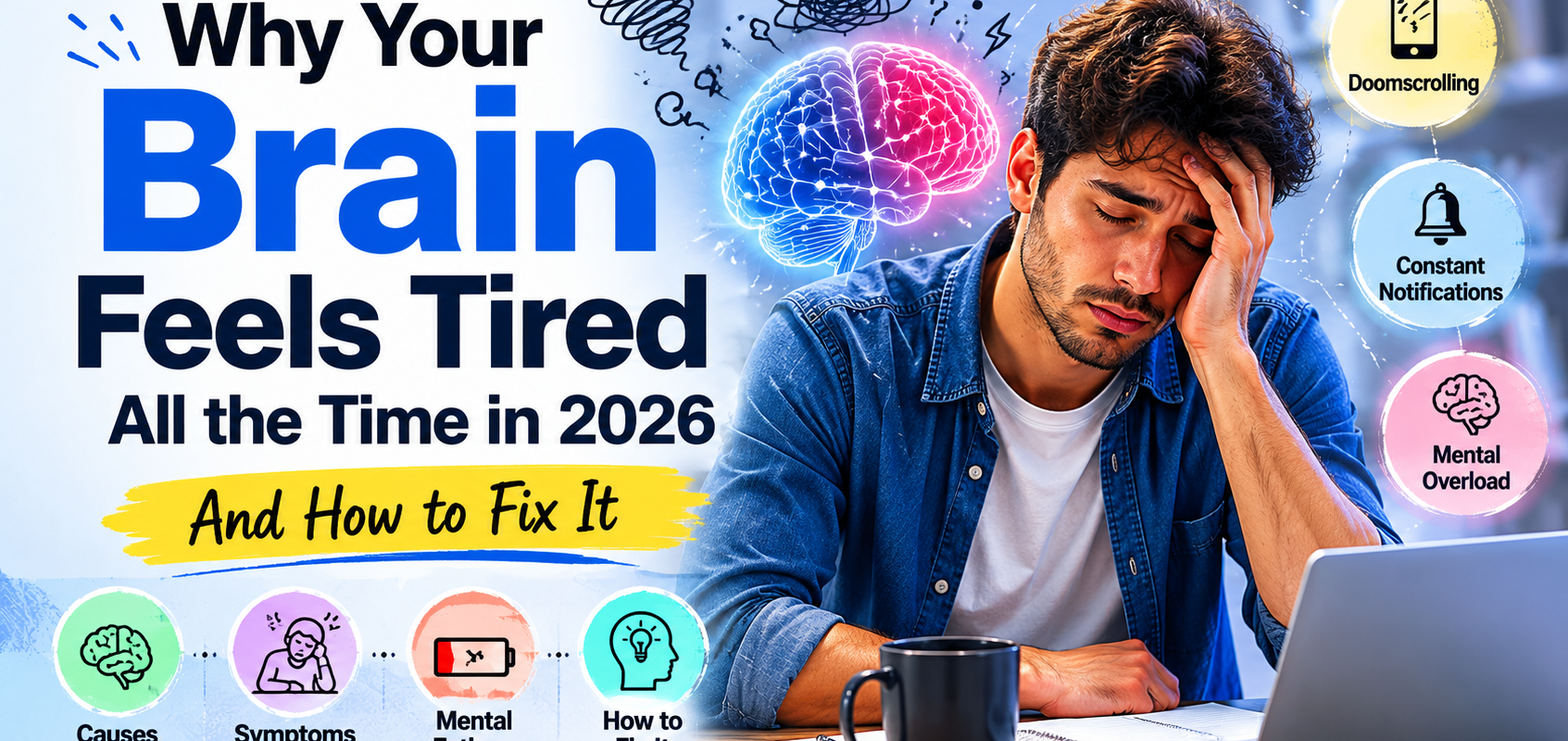
Have you noticed that your brain feels exhausted even when your body isn’t?
You wake up tired.
You struggle to focus.
Simple tasks feel overwhelming.
Your attention span feels broken.
And no matter how much you rest, your mental energy never fully comes back.
Welcome to the modern mental exhaustion epidemic of 2026.
Today’s world is overloaded with notifications, short-form content, AI-generated information, doomscrolling, endless comparisons, and constant stimulation. Your brain is processing more information in a single day than people did in weeks just a decade ago.
The result?
Mental fatigue, digital burnout, brain fog, low motivation, anxiety, and attention collapse.
Searches related to burnout, dopamine overload, focus problems, and consistency are rising rapidly in 2026. Topics like “doomscrolling,” “dopamine management,” and “rebuilding routines after burnout” are among the fastest-growing self-improvement searches online.
This article explains why your brain feels constantly tired and how you can reset your mental energy naturally.
What Is Mental Exhaustion?
Mental exhaustion happens when your brain stays overstimulated for too long without proper recovery.
Unlike physical tiredness, mental fatigue affects:
- Focus
- Memory
- Emotional control
- Motivation
- Decision-making
- Creativity
- Productivity
Your brain may look “active,” but internally it’s overloaded.
Common symptoms include:
- Brain fog
- Low attention span
- Feeling emotionally numb
- Constant procrastination
- Forgetfulness
- Irritability
- Anxiety
- Difficulty enjoying things
- Doomscrolling for hours
- Lack of motivation
In 2026, many people are experiencing “high stimulation burnout” a condition caused by constant digital input without mental recovery.
The Real Reasons Your Brain Feels Tired in 2026
1. Constant Dopamine Overload
Every notification, short video, meme, message, and app gives your brain tiny dopamine spikes.
At first, this feels rewarding.
But over time, your brain becomes overstimulated.
This makes normal activities feel boring:
- Reading
- Studying
- Deep work
- Exercise
- Conversations
- Long-term goals
Experts now call this “dopamine fatigue” or “attention burnout.” Searches related to dopamine management and reducing phone addiction are growing massively in 2026.
Your brain becomes addicted to quick stimulation instead of meaningful focus.
2. Doomscrolling Is Destroying Mental Recovery
Most people never allow their brains to rest anymore.
The moment boredom appears, they grab their phones.
Scrolling endlessly keeps your nervous system active 24/7.
This prevents:
- Deep recovery
- Creative thinking
- Emotional processing
- Mental clarity
One of the fastest-rising self-improvement searches in 2026 is:
“How do I stop doomscrolling every night?”
That alone shows how widespread this problem has become.
3. Information Overload From AI and Content Saturation
AI tools generate endless content every second.
People consume:
- More videos
- More advice
- More opinions
- More news
- More productivity hacks
- More self-improvement content
But consuming more information does not mean growing more.
In fact, excessive content consumption often creates:
- Analysis paralysis
- Confusion
- Anxiety
- Mental clutter
Your brain wasn’t designed to absorb infinite information daily.
Why Motivation Feels Dead
Many people think they are lazy.
Usually, they are mentally overloaded.
Motivation drops when:
- Your attention is fragmented
- Your brain is overstimulated
- Your sleep is poor
- Your dopamine system is exhausted
- Your nervous system never relaxes
This is why even ambitious people struggle to stay disciplined in 2026.
Searches like:
- “How do I stay consistent when motivation fades?”
- “Why can’t I stay disciplined?”
- “How do I rebuild routines after burnout?”
have exploded recently.
Signs Your Brain Needs a Reset
You may need a mental reset if:
- You constantly switch between apps
- You can’t focus for more than a few minutes
- Silence feels uncomfortable
- You feel tired after scrolling
- You procrastinate important tasks
- Your sleep feels unrefreshing
- You consume more than you create
- You feel emotionally drained daily
These are not random problems.
They are symptoms of chronic mental overstimulation.
How to Reset Your Brain and Restore Mental Energy
1. Reduce Dopamine Overload
You do not need to quit technology completely.
But you must reduce excessive stimulation.
Start with:
- Turning off notifications
- Limiting short-form content
- Avoiding phone use after waking up
- Taking breaks from social media
- Keeping your phone away during work
Even small reductions can improve focus dramatically.
2. Train Deep Focus Again
Your attention span is like a muscle.
If you constantly multitask, it weakens.
Rebuild focus by:
- Reading books daily
- Working in 30–60 minute deep focus sessions
- Avoiding multitasking
- Sitting in silence sometimes
- Journaling your thoughts
Your brain slowly adapts back to deeper concentration.
3. Protect Your Sleep
Mental recovery happens during sleep.
Poor sleep increases:
- Brain fog
- Anxiety
- Emotional instability
- Low motivation
- Attention problems
Simple sleep improvements:
- No phone 1 hour before bed
- Sleep at consistent times
- Reduce blue light exposure
- Avoid overstimulation at night
Better sleep improves mental clarity faster than most productivity hacks.
4. Stop Consuming Constant Self-Improvement Content
Many people are addicted to self-improvement without taking action.
They watch:
- Productivity videos
- Motivation reels
- Discipline content
- Morning routine videos
But they rarely implement anything.
Real growth comes from:
- Repetition
- Consistency
- Simplicity
- Action
Not endless consumption.
5. Spend More Time Offline
Your brain needs natural recovery.
Go outside.
Walk without music.
Exercise.
Talk to real people.
Sit quietly.
Spend time in nature.
These activities calm the nervous system and restore mental energy naturally.
The Future of Mental Health in 2026
Mental exhaustion is becoming one of the biggest modern problems.
The world is competing for your attention every second.
Apps, AI platforms, advertisers, and algorithms all want your focus.
Protecting your brain is now a survival skill.
The people who learn to control:
- Their attention
- Their dopamine
- Their habits
- Their digital environment
will have a massive advantage in life.
Final Thoughts
Your brain is not weak.
It’s overloaded.
Modern digital life is pushing human attention beyond healthy limits.
But the good news is this:
Your focus can recover.
Your motivation can return.
Your mental clarity can improve.
The solution is not more stimulation.
The solution is less noise, better habits, deeper focus, and intentional living.
Your brain needs recovery not constant consumption.
FAQs
Why does my brain feel tired even after sleeping?
Mental exhaustion often comes from overstimulation, stress, doomscrolling, poor sleep quality, and excessive screen time rather than physical tiredness alone.
Can social media cause brain fog?
Yes. Excessive social media use can overload dopamine pathways, reduce focus, increase anxiety, and contribute to mental fatigue and brain fog.
What is dopamine overload?
Dopamine overload happens when the brain receives constant high stimulation from apps, notifications, videos, and digital content, making normal tasks feel less rewarding.
How can I improve my attention span again?
Reduce multitasking, limit short-form content, practice deep work sessions, sleep properly, and spend more time offline consistently.
Is digital burnout real?
Yes. Digital burnout is becoming increasingly common due to constant online stimulation, information overload, and lack of mental recovery time.


01 Comment
It only works when I’m Singapore.