
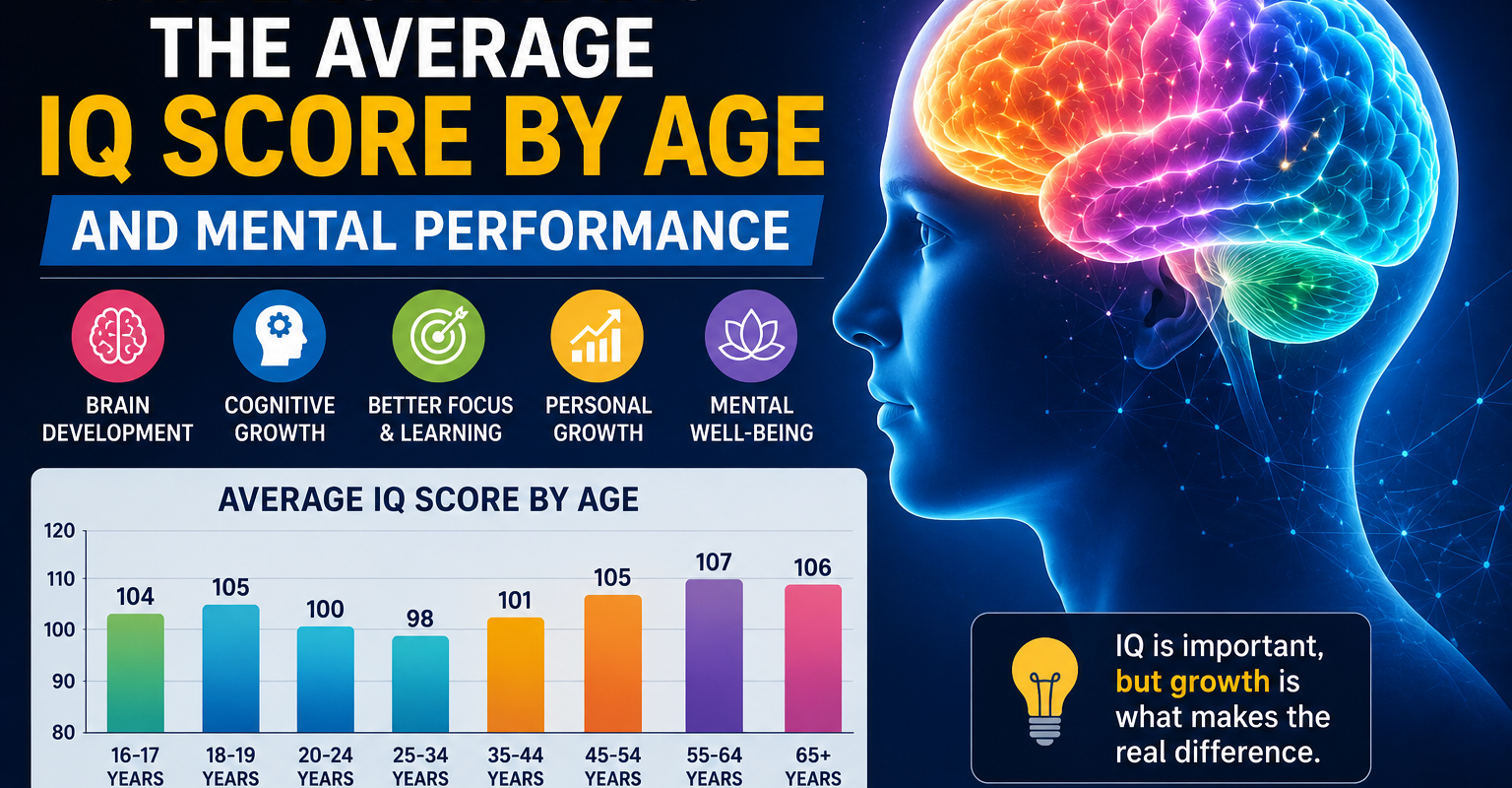
Many people search for the average IQ score by age to understand how intelligence changes throughout life. Intelligence Quotient, commonly called IQ, measures cognitive abilities such as logical thinking, memory, learning speed, reasoning, and problem-solving skills.
However, understanding the average IQ score by age is about more than comparing numbers. Intelligence is closely connected with:
- personal development
- self improvement
- self discipline
- self confidence
- personal growth
- success mindset
- self mastery
Mental performance affects how people learn, work, communicate, and achieve goals. While IQ tests can measure certain thinking abilities, true success also depends on habits, emotional intelligence, discipline, and continuous learning.
In this article, you will learn:
- what IQ means
- the average IQ score by age
- factors affecting mental performance
- whether IQ changes with age
- how to improve intelligence naturally
- why mindset matters more than IQ alone
What Is IQ?
IQ stands for Intelligence Quotient. It is a score used to estimate cognitive abilities and intellectual performance. IQ tests are designed to measure skills such as:
- reasoning
- memory
- problem-solving
- mathematical thinking
- pattern recognition
- verbal understanding
When discussing the average IQ score by age, most experts consider 100 to be the average score for the general population.
People with scores above 100 are considered above average in certain cognitive abilities, while scores below 100 are considered below average. However, IQ does not measure creativity, emotional intelligence, discipline, wisdom, or life experience.
This is important because many people with average IQ scores still achieve extraordinary success through self improvement and consistent personal growth.
Average IQ Score by Age
The average IQ score by age may vary slightly depending on testing systems and research studies. However, most standardized tests follow a similar range.
Below is a general overview of the average IQ score by age:
| Age Group | Average IQ Score |
|---|---|
| 16–17 years | Around 108 |
| 18–19 years | Around 105 |
| 20–24 years | Around 99–100 |
| 25–34 years | Around 97–101 |
| 35–44 years | Around 101 |
| 45–54 years | Around 106 |
| 55–64 years | Around 109 |
| 65+ years | Varies depending on mental health and lifestyle |
The average IQ score by age should only be used as a general reference. Intelligence is influenced by many factors including:
- education
- lifestyle
- environment
- stress levels
- sleep quality
- learning habits
People focused on personal development often improve their cognitive abilities through continuous learning and healthy routines.
Does IQ Change With Age?
One common question related to the average IQ score by age is whether intelligence changes over time.
The answer is yes. Some mental abilities improve with age, while others may slow down slightly.
For example:
- vocabulary and knowledge often increase with age
- emotional intelligence improves through life experience
- processing speed may decrease over time
- wisdom and decision-making skills usually become stronger
This means the average IQ score by age does not fully define a person’s mental capability or future success.
People who focus on self development and learning can continue improving brain performance throughout life.
Factors That Affect Mental Performance
Mental performance is influenced by many daily habits and lifestyle choices. Understanding these factors can help improve focus, memory, and overall intelligence.
Education and Learning
Learning new information strengthens neural connections in the brain. Reading, studying, and developing new skills support long-term mental growth.
Sleep Quality
Poor sleep negatively affects concentration, memory, and reasoning skills. Good sleep improves cognitive performance and supports healthier brain function.
Nutrition
Healthy foods rich in vitamins, antioxidants, and omega-3 fatty acids help support mental clarity and focus.
Physical Exercise
Exercise increases blood circulation to the brain and improves memory and concentration.
Stress Management
High stress levels can reduce focus and mental clarity. Chronic stress negatively affects brain performance over time.
Understanding the average IQ score by age becomes more meaningful when people focus on improving the habits that support mental performance.
Why IQ Is Not the Only Measure of Intelligence
Many people mistakenly believe IQ alone determines success. In reality, intelligence is much broader than a test score.
The average IQ score by age only measures certain cognitive abilities. Real-world success also depends on:
- emotional intelligence
- communication skills
- adaptability
- confidence
- discipline
- creativity
- persistence
A person with an average IQ but strong self discipline and a powerful success mindset can often outperform someone with a higher IQ but poor habits.
This is why personal growth matters more than comparison.
The Connection Between IQ and Self Improvement
There is a strong connection between intelligence and self improvement. People interested in growth often focus on strengthening both the mind and lifestyle habits.
Improving mental performance can help with:
- productivity
- confidence
- learning ability
- focus
- goal achievement
People working on self mastery often practice habits like:
- reading daily
- journaling
- meditation
- exercise
- continuous learning
These habits support both cognitive growth and emotional development.
Understanding the average IQ score by age should inspire people to improve themselves rather than compare themselves unfairly to others.
Can You Improve Your Intelligence?
Yes, mental performance can improve over time.
The brain has the ability to adapt and create new neural connections through a process called neuroplasticity. This means intelligence and mental skills are not completely fixed.
Ways to improve cognitive performance include:
- reading books regularly
- learning new skills
- solving puzzles
- exercising consistently
- reducing digital distractions
- practicing mindfulness
- sleeping properly
These habits strengthen focus, memory, and concentration while supporting long-term personal growth.
People who consistently challenge their minds often develop stronger confidence and improved learning abilities.
Self Discipline and Brain Performance
One of the most underrated factors in mental success is self discipline.
Good habits improve:
- focus
- productivity
- memory
- emotional control
- learning ability
Simple routines like avoiding excessive social media, maintaining a study schedule, and exercising regularly can improve mental performance significantly.
People who practice discipline consistently often experience:
- better concentration
- stronger self confidence
- higher motivation
- improved productivity
The combination of discipline and continuous learning creates real life transformation over time.
IQ, Confidence, and Personal Growth
Many people connect intelligence with confidence, but true confidence comes from growth and progress.
Understanding the average IQ score by age can help people stop comparing themselves to unrealistic standards.
Everyone has unique strengths such as:
- creativity
- leadership
- emotional intelligence
- communication skills
- resilience
Building self confidence requires:
- learning from mistakes
- improving daily habits
- staying consistent
- developing a positive mindset
Confidence grows through action, not just intelligence scores.
Building a Success Mindset
A strong success mindset is often more important than raw intelligence.
Successful people usually:
- stay disciplined
- learn continuously
- adapt to challenges
- remain consistent
- focus on long-term growth
This mindset helps people improve regardless of their starting point.
Understanding the average IQ score by age should motivate people to invest in learning, discipline, and self growth rather than focusing only on numbers.
Life Purpose and Continuous Learning
People pursuing their life purpose often focus on constant learning and self development.
The brain becomes stronger through:
- experience
- education
- reflection
- practice
- curiosity
Mental growth is a lifelong journey. Intelligence becomes truly valuable when combined with purpose, discipline, and emotional balance.
The average IQ score by age is only one small part of human potential.
Final Thoughts
Understanding the average IQ score by age can provide insight into cognitive performance and mental development throughout life. However, intelligence is much more than a number on a test.
True success also depends on:
- personal development
- self improvement
- self confidence
- self discipline
- personal growth
- self mastery
- success mindset
People can improve mental performance through healthy habits, learning, discipline, and consistency. The brain has the ability to adapt and grow throughout life.
Instead of comparing IQ scores, focus on becoming a better version of yourself every day. Continuous growth, discipline, and learning are the real foundations of long-term success and meaningful life transformation.